STUDY PROGRAM

STEAM Education

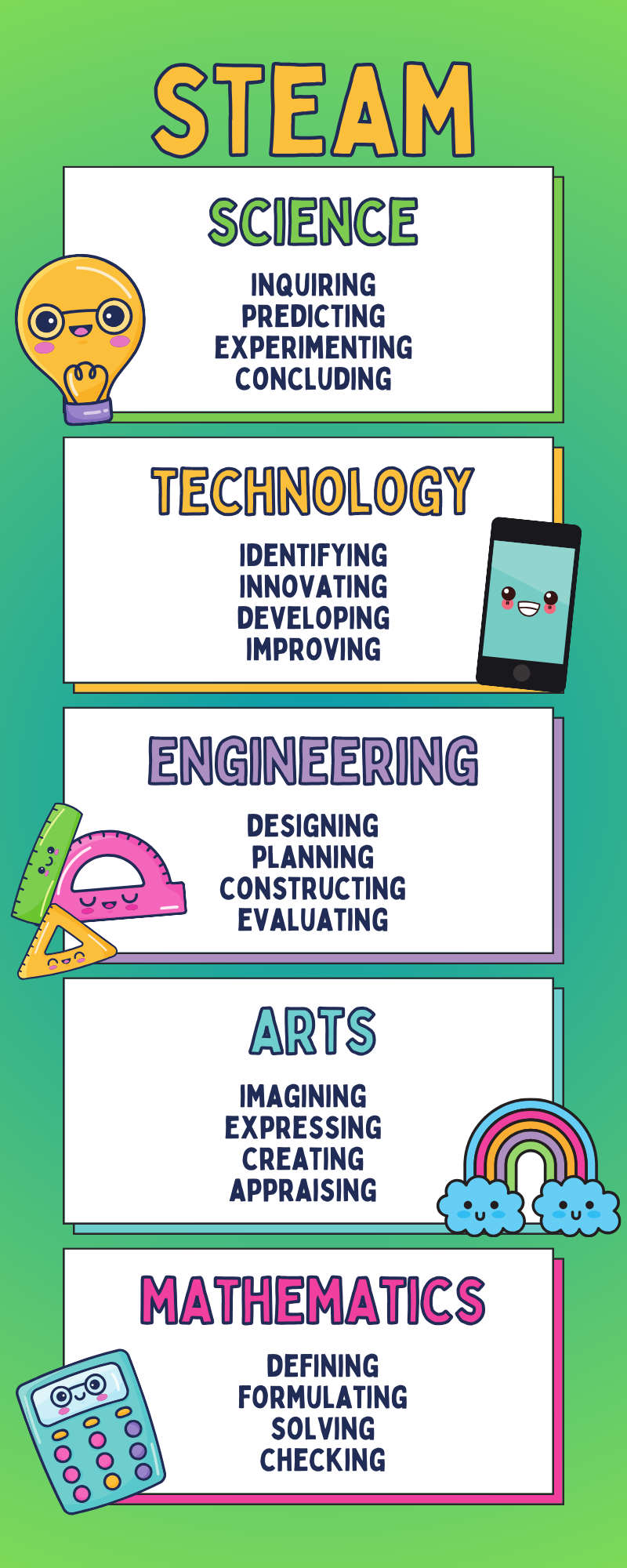
STEAM is a modern interdisciplinary educational approach that integrates knowledge and skills from five fields: Science, Technology, Engineering, Arts, and Mathematics.

Building on the STEM approach, STEAM incorporates Art to create a more holistic learning experience, encouraging students to connect knowledge across disciplines and explore ideas from multiple perspectives.

The STEAM approach promotes active and creative learning through real-world situations and hands-on experiences. Each learning activity is designed to spark students’ curiosity, encourage exploration, and develop their ability to think critically and solve problems.

Through this approach, students gradually build essential skills while learning to explore and address real-world challenges with creativity, confidence, and diverse perspectives.

How STEAM Education Supports Students’ Development

By integrating Science, Technology, Engineering, Arts, and Mathematics, STEAM provides students with a diverse and holistic learning experience while developing essential skills:

  • 🔬 Science: Understanding concepts, principles, and how things work, then applying knowledge to real-life situations.
  • 💻 Technology: Exploring modern technology and creating scientific products and models appropriate to their age.
  • ⚙️ Engineering: Learning through hands-on projects such as building and assembling simple machines or robots, while developing creativity and problem-solving skills.
  • 🎨 Arts: Encouraging imagination, creativity, and self-expression through music, visual arts, movement, and other artistic activities.
  • 🔢 Mathematics: Building an early foundation in mathematical thinking, number sense, logical reasoning, and practical application.

10 Key Benefits of STEAM Education at VAUIS

At VAUIS, STEAM is designed around experiential learning, allowing students to learn by doing, explore through curiosity, and develop creative thinking.

1. Strengthening Critical Thinking

Students are encouraged to ask questions, observe, analyze information, and draw their own conclusions, developing logical and independent thinking.

2. Enhancing Problem-Solving Skills

Through a process of trial, error, and adjustment, students learn to approach challenges calmly, identify solutions, and improve their work.

3. Fostering Creativity and Curiosity

Hands-on projects give students the freedom to experiment, explore new ideas, and create products in their own unique ways.

4. Building Collaboration Skills

Group projects teach students how to share responsibilities, listen to others, discuss ideas, and work together toward a common goal.

5. Improving Communication Skills

Presenting ideas and projects helps students communicate clearly, confidently express their thoughts, and respond positively to feedback.

6. Developing Perseverance

When an experiment or model does not work as expected, students learn to identify the cause, make adjustments, and try again. This helps build resilience and a willingness to overcome challenges.

7. Connecting Learning to Real Life

Experiments, models, and practical activities help students see how concepts from Mathematics and Science are connected to the world around them.

8. Introducing Modern Technology

Students have opportunities to explore digital tools, educational robotics, and basic programming, helping them develop digital awareness and prepare for an increasingly technology-driven world.

9. Reinforcing Academic Knowledge

By actively experimenting, observing, and drawing conclusions, students gain a deeper understanding of concepts and learn to apply knowledge beyond the textbook.

10. Exploring Future Career Interests

Early exposure to Science, Technology, Engineering, and Programming allows students to discover their interests and strengths, providing a foundation for future learning and career exploration.


STEAM at VAUIS: Learning Today, Preparing for Tomorrow

At VAUIS, we believe that STEAM education gives primary students a strong foundation for the future. Through a creative, engaging, and experiential approach, our STEAM program nurtures logical thinking, collaboration, communication, creativity, and real-world application.

More than making learning enjoyable, these experiences equip students with the essential skills they need to adapt, grow, and thrive in a rapidly changing world.


STUDY PROGRAM

STEAM Education

STEAM is a modern interdisciplinary educational approach that integrates knowledge and skills from five fields: Science, Technology, Engineering, Arts, and Mathematics.

Building on the STEM approach, STEAM incorporates Art to create a more holistic learning experience, encouraging students to connect knowledge across disciplines and explore ideas from multiple perspectives.

The STEAM approach promotes active and creative learning through real-world situations and hands-on experiences. Each learning activity is designed to spark students’ curiosity, encourage exploration, and develop their ability to think critically and solve problems.

Through this approach, students gradually build essential skills while learning to explore and address real-world challenges with creativity, confidence, and diverse perspectives.

How STEAM Education Supports Students’ Development

By integrating Science, Technology, Engineering, Arts, and Mathematics, STEAM provides students with a diverse and holistic learning experience while developing essential skills:

  • 🔬 Science: Understanding concepts, principles, and how things work, then applying knowledge to real-life situations.
  • 💻 Technology: Exploring modern technology and creating scientific products and models appropriate to their age.
  • ⚙️ Engineering: Learning through hands-on projects such as building and assembling simple machines or robots, while developing creativity and problem-solving skills.
  • 🎨 Arts: Encouraging imagination, creativity, and self-expression through music, visual arts, movement, and other artistic activities.
  • 🔢 Mathematics: Building an early foundation in mathematical thinking, number sense, logical reasoning, and practical application.

10 Key Benefits of STEAM Education at VAUIS

At VAUIS, STEAM is designed around experiential learning, allowing students to learn by doing, explore through curiosity, and develop creative thinking.

1. Strengthening Critical Thinking

Students are encouraged to ask questions, observe, analyze information, and draw their own conclusions, developing logical and independent thinking.

2. Enhancing Problem-Solving Skills

Through a process of trial, error, and adjustment, students learn to approach challenges calmly, identify solutions, and improve their work.

3. Fostering Creativity and Curiosity

Hands-on projects give students the freedom to experiment, explore new ideas, and create products in their own unique ways.

4. Building Collaboration Skills

Group projects teach students how to share responsibilities, listen to others, discuss ideas, and work together toward a common goal.

5. Improving Communication Skills

Presenting ideas and projects helps students communicate clearly, confidently express their thoughts, and respond positively to feedback.

6. Developing Perseverance

When an experiment or model does not work as expected, students learn to identify the cause, make adjustments, and try again. This helps build resilience and a willingness to overcome challenges.

7. Connecting Learning to Real Life

Experiments, models, and practical activities help students see how concepts from Mathematics and Science are connected to the world around them.

8. Introducing Modern Technology

Students have opportunities to explore digital tools, educational robotics, and basic programming, helping them develop digital awareness and prepare for an increasingly technology-driven world.

9. Reinforcing Academic Knowledge

By actively experimenting, observing, and drawing conclusions, students gain a deeper understanding of concepts and learn to apply knowledge beyond the textbook.

10. Exploring Future Career Interests

Early exposure to Science, Technology, Engineering, and Programming allows students to discover their interests and strengths, providing a foundation for future learning and career exploration.


STEAM at VAUIS: Learning Today, Preparing for Tomorrow

At VAUIS, we believe that STEAM education gives primary students a strong foundation for the future. Through a creative, engaging, and experiential approach, our STEAM program nurtures logical thinking, collaboration, communication, creativity, and real-world application.

More than making learning enjoyable, these experiences equip students with the essential skills they need to adapt, grow, and thrive in a rapidly changing world.


STUDY PROGRAM

STEAM Education

STEAM is a modern interdisciplinary educational approach that integrates knowledge and skills from five fields: Science, Technology, Engineering, Arts, and Mathematics.

Building on the STEM approach, STEAM incorporates Art to create a more holistic learning experience, encouraging students to connect knowledge across disciplines and explore ideas from multiple perspectives.

The STEAM approach promotes active and creative learning through real-world situations and hands-on experiences. Each learning activity is designed to spark students’ curiosity, encourage exploration, and develop their ability to think critically and solve problems.

Through this approach, students gradually build essential skills while learning to explore and address real-world challenges with creativity, confidence, and diverse perspectives.

How STEAM Education Supports Students’ Development

By integrating Science, Technology, Engineering, Arts, and Mathematics, STEAM provides students with a diverse and holistic learning experience while developing essential skills:

  • 🔬 Science: Understanding concepts, principles, and how things work, then applying knowledge to real-life situations.
  • 💻 Technology: Exploring modern technology and creating scientific products and models appropriate to their age.
  • ⚙️ Engineering: Learning through hands-on projects such as building and assembling simple machines or robots, while developing creativity and problem-solving skills.
  • 🎨 Arts: Encouraging imagination, creativity, and self-expression through music, visual arts, movement, and other artistic activities.
  • 🔢 Mathematics: Building an early foundation in mathematical thinking, number sense, logical reasoning, and practical application.

10 Key Benefits of STEAM Education at VAUIS

At VAUIS, STEAM is designed around experiential learning, allowing students to learn by doing, explore through curiosity, and develop creative thinking.

1. Strengthening Critical Thinking

Students are encouraged to ask questions, observe, analyze information, and draw their own conclusions, developing logical and independent thinking.

2. Enhancing Problem-Solving Skills

Through a process of trial, error, and adjustment, students learn to approach challenges calmly, identify solutions, and improve their work.

3. Fostering Creativity and Curiosity

Hands-on projects give students the freedom to experiment, explore new ideas, and create products in their own unique ways.

4. Building Collaboration Skills

Group projects teach students how to share responsibilities, listen to others, discuss ideas, and work together toward a common goal.

5. Improving Communication Skills

Presenting ideas and projects helps students communicate clearly, confidently express their thoughts, and respond positively to feedback.

6. Developing Perseverance

When an experiment or model does not work as expected, students learn to identify the cause, make adjustments, and try again. This helps build resilience and a willingness to overcome challenges.

7. Connecting Learning to Real Life

Experiments, models, and practical activities help students see how concepts from Mathematics and Science are connected to the world around them.

8. Introducing Modern Technology

Students have opportunities to explore digital tools, educational robotics, and basic programming, helping them develop digital awareness and prepare for an increasingly technology-driven world.

9. Reinforcing Academic Knowledge

By actively experimenting, observing, and drawing conclusions, students gain a deeper understanding of concepts and learn to apply knowledge beyond the textbook.

10. Exploring Future Career Interests

Early exposure to Science, Technology, Engineering, and Programming allows students to discover their interests and strengths, providing a foundation for future learning and career exploration.


STEAM at VAUIS: Learning Today, Preparing for Tomorrow

At VAUIS, we believe that STEAM education gives primary students a strong foundation for the future. Through a creative, engaging, and experiential approach, our STEAM program nurtures logical thinking, collaboration, communication, creativity, and real-world application.

More than making learning enjoyable, these experiences equip students with the essential skills they need to adapt, grow, and thrive in a rapidly changing world.